October 25, 2026
Cutting Food Costs
This one simple trick helped us cut our restaurant spending by two-thirds...though it wasn't simple, and not just a trick...it was a true family lifestyle change
This is not a feel-good story that I’m happy to write details about and share with the world, but the outcome is very good, so it’s worth sharing. As I look back at the numbers, I’m devastated by how much money me and my family threw down the drain on convenient food options, but I’m hoping by sharing our experience it can help some of you before it gets as out of hand as it got for us.
Let me clarify, dining out is not something I’m trying to stigmatize here in this post; however, I want to draw attention to how quickly and easily it can get out of hand, especially when we were feeding a family of four. We still go out to restaurants, we still drive thru at McDonalds, and we sometimes even still order through delivery apps. However, there was a time when my family seemed to be addicted to this routine of eating out.
To set the stage, me and my family have been in a fortunate position to have some luxuries in our lives. At the peak of my income earning, I was raking in plenty of cash to afford us the convenience of frequent fast food orders, and an embarassingly high monthly DoorDash bill. On those tired evenings, we found it so much easier to drive thru or order delivery because we failed to plan, or we were too drained to execute against a plan to cook meals.
In 2025, 45% of everything we spent on food went to restaurants and delivery. Nearly half of our food budget was spent feeding my family by having someone else cook for us. Our favorites included McDonalds, Tex-Mex, Panera, Donuts, tacos (oh so many tacos), and much much more. The grocery store got the other 55%.
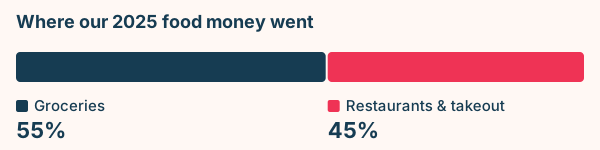
Unfortunately in the middle of this family addiction to outside food, it was hard to see what situation we were in. However, looking back it should have been blatantly obvious how frequently we dined out vs. cooked at home. These numbers work out to 83 cents spent on outside food for every dollar we spent at the grocery store. Let me repeat that….for every grocery run, we were spending almost as much again to have someone else make our meals, all 365 days of the year. Breaking it down to that level gives me a tremendous amount of shame that I wish I realized sooner.
When I stepped away from my career and our income dropped to zero this became a major expense category that came under the microscope for our family, and I’m SO glad it did because we were able to make huge improvements once we realized how much of our money was going to this area. Looking back from the beginning of 2025 until today, you can see most months landed right around our 2025 monthly average. In June/July we had some vacation spending that kept those months high, but we got really serious about cutting back restaurant spend to 42% of that average in August and down further to 32% in September.
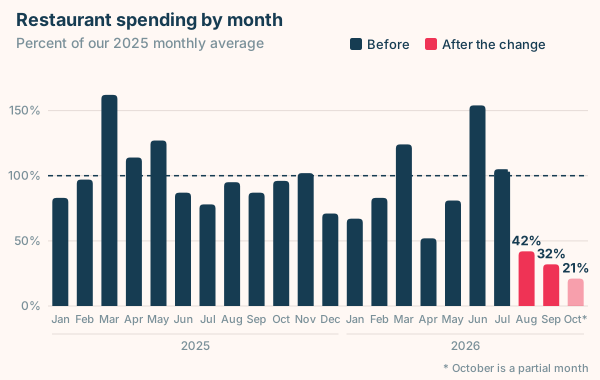
Of course when me and my wife were discussing this reduction in spending it required us to both be on-board with a big lifestyle change. It meant dining out was now a rarity, and it meant cooking at home was the norm. We not only targeted dinners, but ensured for lunches we needed to be eating at home or taking a lunch to work. Naturally, when we were first planning this lifestyle change we anticipated a small increase in grocery spending because logic dictates that we aren’t getting food from restaurants and delivery so we must get food from somewhere else. Much to our surprise, a couple months into this transition and our grocery spend has been roughly the same as it was before. Our grocery bill in the last few months of cooking more at home has stayed right around our 2025 monthly average. I can see two potential reasons for this. Firstly, I believe we had a very large amount of food waste occurring in the before times. I remember times where we would ambitiously plan a meal, cook a meal, then see the leftovers rot in the fridge for a week while we stacked up fast food cartons in the trash bins for several nights in a row. With our new commitment to eating at home leftovers are the “convenient” food option because the prep time is drastically reduced vs cooking a fresh meal (and we don’t have to wait in a drive thru line). Secondly, with grocery prices ever increasing, we have been more deliberate about the foods that we buy and prepare. I’ve had the luxury to spend time learning how to use raw produce, meats, and staples rather than purchasing pre-packaged processed foods and meals. It’s now becoming habit for me to reach for the lower priced, yet higher quality, fresh ingredient instead of the packaged processed alternative. My software engineering brain sometimes even makes a game figuring out how many more meals we can squeeze from a 5lb bag of rice vs. the box of Minute Rice that we use to stock in our pantry. We are also more aware of seasonal fresh produce and choose those options when the price is right.
The lovely side benefit is that I’m actually learning how to cook better foods for my family. I still reach for recipes frequently, but I’m also finding myself more capable of improvising in the kitchen if we don’t have the exact prescribed ingredients. I’m finding joy in digging deep in our freezer to utilize nearly forgotten items that would have gone to waste in the before times. We have consistently stocked fresh lettuce for lunch salads, potatoes on a weekly basis, and lots of bags of frozen veggies that make for a quick side dish for almost any dinner.
Financially and gastronomically, we are nowhere near perfect, but I’ve taken a lot of pride seeing this improvement in my family’s lifestyle that started as an economic neccesity, but has led to more healthy eating for the whole family. On a monthly basis, this change helped us cut our restaurant spending by about two-thirds!!! That’s huge savings!